8.4%
Missed-appointment rate after a revised SMS reminder in a UK outpatient trial.
Airlines, OTAs, Hotels, Mobility Platforms, And Travel Operators Already Have Customer Channels.
But Care Still Gets Delayed When The Patient Does Not Know What To Do Next
The Communication Gap In Healthcare Is Not Lack Of Outreach.
It Is The Absence Of A Connected Layer That Can Guide Patients From Message To Action Without Losing Privacy, Context, Or Urgency.

Missed-appointment rate after a revised SMS reminder in a UK outpatient trial.
Missed-appointment rate for the existing reminder in the same trial.
Reduction in primary-care no-shows from an additional targeted reminder in a Kaiser Permanente Washington study.
Healthcare communication does not usually fail dramatically.
It fails quietly.
Together, They Create Wasted Clinical Capacity, Longer Queues, Avoidable Calls, Anxious Patients, And Teams That Spend Their Day Repeating The Same Instructions Across Disconnected Channels.
That Is Why Healthcare Communication Cannot Be Treated As Generic Messaging.
It Has To Behave Like Patient-Access Infrastructure.
It Must Know What The Patient Is Trying To Do. It Must Understand The Appointment Or Care Context. It Must Protect Sensitive Details. It Must Guide The Next Step.
And When The Situation Needs A Human, It Must Escalate With Enough Context For The Team To Act Immediately.
A Better Reminder Reduced Missed Outpatient Visits.
A UK Randomized Trial Found That Adding The Specific Cost Of A Missed Appointment Lowered Did-Not-Attend Rates Versus The Existing Reminder.
Small Changes Can Recover Large Amounts Of Care Capacity.
The Same Study Estimated That Switching To The More Effective Reminder Could Prevent About 5,800 Missed Appointments Per Year At The NHS Trust Studied.
Targeted Reminders Work Better When Risk Is Understood.
Kaiser Permanente Washington Randomized 125,076 Primary-Care Visits And Found An Additional Reminder Reduced No-Shows By 7% For High-Risk Visits.
A delivered reminder does not guarantee attendance. Patients need clear timing, importance, instructions, and a simple way to cancel or reschedule.
Diagnostics, procedures, and specialist visits often depend on patient preparation. If instructions are missed, the appointment may still fail.
Health concerns, reports, prescriptions, and identity details can appear inside ordinary conversations. The system must protect sensitive information by default.
A reschedule is not just a calendar edit. It affects doctor availability, department load, patient urgency, and care continuity.
Lab, pharmacy, billing, consultation, and care teams often respond separately. The patient experiences one journey, but the system sees fragments.
When a patient finally reaches a human, the team should already know the message history, visit type, attempted action, and urgency.
That Is No Longer Enough.
A Healthcare-Grade Communication Layer Should Notice Intent, Understand Visit Context, Protect Sensitive Information, Offer The Right Next Action, And Escalate When The Patient Needs Human Attention.
It Should Help The Patient Confirm, Reschedule, Prepare, Ask, Update, Or Complete The Next Step.
This Is Not About Automating Care.
It Is About Making Sure The Communication Around Care Does Not Become The Reason Care Gets Delayed.
 :
:Identify Appointment, Report, Prescription, Billing, Care Instruction, Or Follow-Up Intent.
Match Patient, Visit Type, Department, Provider, Timing, And Prior Conversation History.
Detect Sensitive Details And Keep Private Health Information Inside Safe Handling Boundaries.
Give The Patient The Next Clear Action: Confirm, Reschedule, Prepare, Pay, Upload, Or Speak To A Care Team.
Help The Clinic Refill Slots, Avoid Missed Visits, And Reduce Repeat Calls Before The Issue Becomes Operational Drag.
Route Clinical, Urgent, Ambiguous, Or Sensitive Cases To The Right Human Team With Full Context.
Route Clinical, Urgent, Ambiguous, Or Sensitive Cases To The Right Human Team With Full Context.
Help The Clinic Refill Slots, Avoid Missed Visits, And Reduce Repeat Calls Before The Issue Becomes Operational Drag.
Give The Patient The Next Clear Action: Confirm, Reschedule, Prepare, Pay, Upload, Or Speak To A Care Team.
Preserve The Message History, Patient Action, Handoff, And Communication Trail.
Connects Patient Conversations To Care OperationsIt Is The Communication Layer Between Patients, Care Teams, And Operational Systems.
It Helps Healthcare Organizations Understand Patient Intent, Retrieve Appointment Context, Protect Sensitive Information, Guide The Next Step, And Escalate Safely When Human Review Is Required.
Across WhatsApp, SMS, RCS, Instagram, And Telegram, The Patient Conversation Remains Connected To The Care Journey.
Recognize confirmations, cancellations, reschedules, late arrivals, report questions, prescription queries, and preparation issues.
Connect the conversation to department, doctor, slot type, patient history, and prior communication.
Detect sensitive information and keep patient data within controlled communication boundaries.
Guide patients to the right next action while helping teams protect schedule capacity.
Escalate clinical, urgent, or sensitive conversations with the full context already prepared.
Preserve messages, patient choices, slot changes, reminders, and handoff history.
Schedule changes become care continuity.
Resolution Path
Dootiq identifies the reschedule request, checks visit type and slot rules, offers eligible alternatives, confirms the new appointment, and sends preparation instructions.
Outcome
The patient stays on the care path and the clinic gets a chance to recover the original slot.
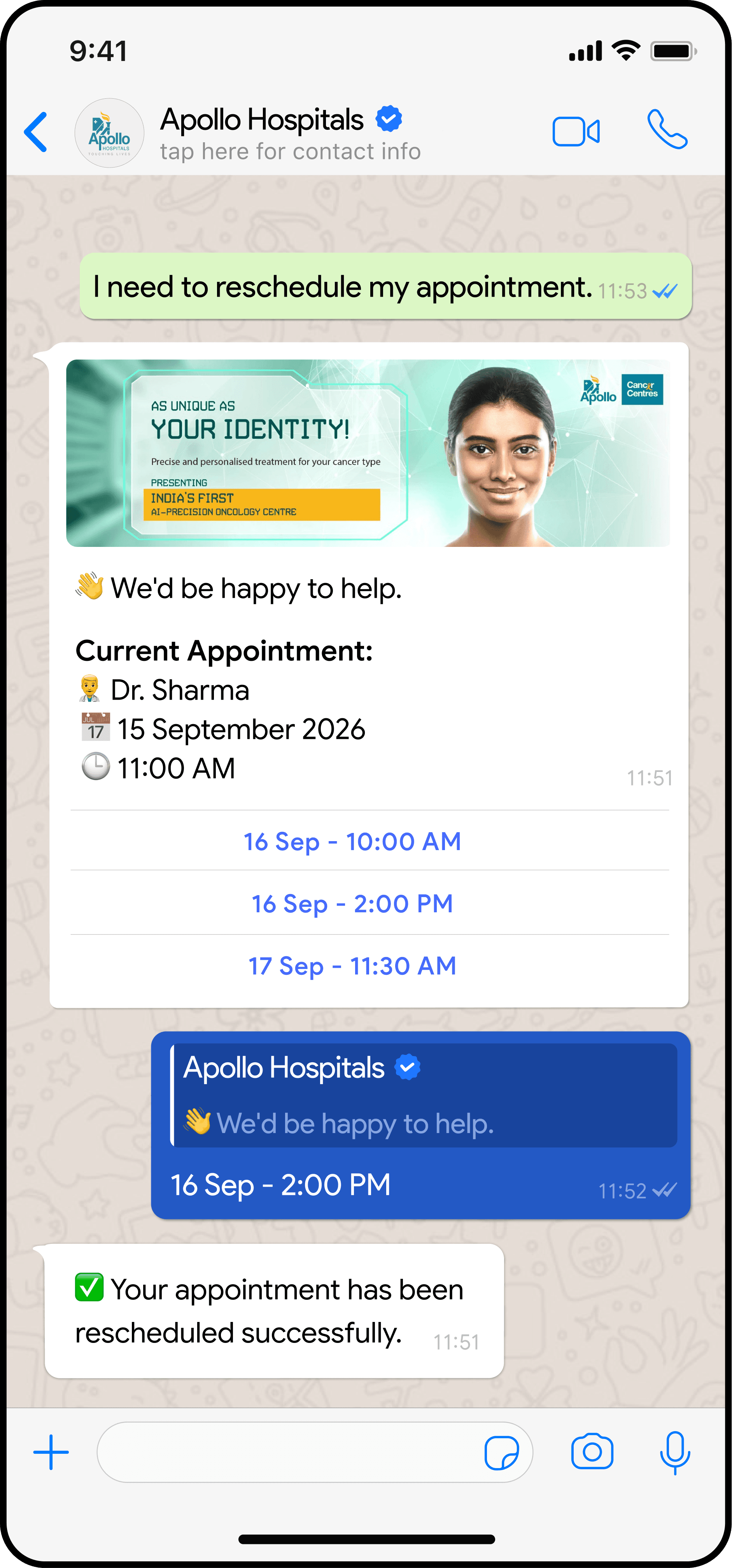
Healthcare Teams Cannot Treat Patient Messages Like Ordinary Support Tickets.
That Means Communication Infrastructure Must Be Built Around Privacy, Access Control, And Safe Escalation.
Was The Message Delivered?
Was The Patient Guided Safely, And Can The Organization Show What Happened?
Patient Details And Health-Related Context Need Controlled Treatment Across Every Channel.
Confirmations, Cancellations, Reschedules, Instructions, And Handoffs Remain Traceable.
Clinical, Urgent, Ambiguous, Or Privacy-Sensitive Requests Should Move To Human Teams With Context Intact.
Patients Can Move Across Channels Without Forcing Staff To Reconstruct The Conversation.
Editorial Article
The real question is whether the patient receives the right next step at the right moment, in a form they can act on.
Published evidence shows how much this matters.
Enterprise cloud communication built for security, scalability, and intelligent engagement.