
Metric One
21x
Higher odds of qualifying a web lead when contacted within five minutes versus waiting thirty minutes.
Real Estate Teams Already Collect Leads From Everywhere
But Conversion Still Breaks When Buyer Intent Is Not Handled In The Moment It Appears
A Prospect Asks For Price.
A Buyer Wants Availability.
A Family Asks About Possession.
An Investor Asks For Rental Yield.
A Lead Wants A Site Visit.
A Channel Partner Needs Inventory Clarity.
A Serious Enquiry Waits While A Sales Team Is Busy.
The Communication Gap In Real Estate Is Not Lead Generation
It Is The Absence Of A Connected Layer That Can Qualify Intent, Answer Project Questions, Match Inventory, Book The Next Action, And Hand Off Hot Prospects Before They Lose Momentum.

Metric One
Higher odds of qualifying a web lead when contacted within five minutes versus waiting thirty minutes.
Metric Two
Share of buyers who found the home they purchased online, according to NAR data cited by Investopedia.
Metric Three
First-time buyers' share of U.S. home purchases in NAR's 2024 profile, a 43-year low reported by MarketWatch.
Real Estate Teams Often Think The Sale Begins When The Buyer Arrives At The Property.
It Does Not. It Begins When The Buyer Raises Their Hand.
That First Moment Carries Intent.
But Real Estate Operations Are Usually Fragmented. Leads Arrive From Multiple Platforms. Inventory Sits In One Sheet. Pricing Lives With Sales. Payment Plans Are Explained Manually. Site Visits Are Coordinated On Calls. Follow-Ups Depend On Individual Agents.
By The Time The Team Responds, The Buyer May Have Already Spoken To Another Developer, Another Broker, Or Another Project.
The Problem Is Not That Real Estate Lacks Leads.
The Problem Is That Buyer Intent Expires Faster Than Most Teams Respond.
Real Estate Communication Needs To Behave Like Conversion Infrastructure.
It Must Understand The Buyer’s Question.
It Must Know The Project And Inventory Context.
It Must Qualify Seriousness.
It Must Move The Buyer Toward A Site Visit Or Sales Conversation.
And When A Human Joins, They Should Already Know What The Buyer Wants.
Lead Response Speed Changes Qualification Outcomes.
The Lead Response Management Study found that contacting a web lead within five minutes dramatically improves qualification odds compared with waiting thirty minutes.
Property Discovery Has Moved Online.
NAR data cited by Investopedia says 51% of buyers found the home they purchased online, rising to 61% among buyers in their twenties.
Buyer Hesitation Is Rising As Affordability Tightens.
NAR's 2024 profile showed first-time buyers fell to 24% of U.S. home purchases, the lowest share since NAR began tracking the data in 1981.
A buyer who submits a form is often still browsing. If the first response is slow, the conversation may move to another project.
Generic “starting from” replies rarely move a serious buyer. They want unit type, floor, offer, payment plan, and availability.
Available units, blocked inventory, sold-out configurations, and launch-phase offers often live across teams and spreadsheets.
A buyer may be interested now, but if scheduling requires multiple calls, the visit may never happen.
Broker and partner enquiries often require project, inventory, pricing, and payout clarity before they can move their own buyer forward.
When a lead finally reaches an agent, the team should already know the project, budget, unit type, timeline, and conversation history.
That is no longer enough.
A real-estate-grade communication layer should recognize buyer intent, map the enquiry to project context, answer the first commercial questions, qualify readiness, book the next action, and hand off serious buyers with full context.
It should help the buyer ask, compare, qualify, schedule, visit, negotiate, document, and decide without restarting the conversation.
 :Operating Model
This Is Not About Replacing Real Estate Sales Teams
It Is About Ensuring The Sales Team Enters The Conversation At The Right Moment, With The Buyer Already Warmed, Qualified, And Understood.
Identify pricing, availability, possession, site visit, location, loan, offer, broker, or callback intent.
Connect the enquiry to project, inventory, unit type, budget, location, source, and prior messages.
Understand buyer seriousness, timeline, budget, family/investment intent, and next-step readiness.
Provide specific project guidance instead of generic brochure replies.
Offer site visit, callback, virtual tour, or sales consultation slots.
Route high-intent, high-budget, partner, or exception cases to sales teams with complete context.
Route high-intent, high-budget, partner, or exception cases to sales teams with complete context.
Offer site visit, callback, virtual tour, or sales consultation slots.
Provide specific project guidance instead of generic brochure replies.
Preserve enquiry history, preferences, follow-ups, visit status, and sales handoff notes.
connects real estate enquiries to sales operations.It is the communication layer between buyers, campaigns, project data, sales teams, channel partners, and site-visit workflows.
It helps real estate teams understand buyer intent, retrieve project and inventory context, answer first questions, qualify seriousness, book next steps, and escalate high-intent leads with full briefing.
Across WhatsApp, SMS, RCS, Instagram, and Telegram, the buyer conversation remains connected to the sales journey.
Recognize pricing, availability, possession, site visit, location, callback, loan, offer, and broker enquiries.
Connect conversations to project, tower, unit type, inventory, price band, possession, and campaign source.
Capture budget, timeline, preferred configuration, buying purpose, location preference, and readiness to visit.
Move high-intent prospects from enquiry to scheduled visit or callback before they go cold.
Give channel partners faster project, inventory, and process clarity without manual sales-team dependency.
Escalate hot leads with buyer profile, interest, objections, project, conversation history, and suggested next step.
From enquiry to qualified sales handoff.
Resolution Path
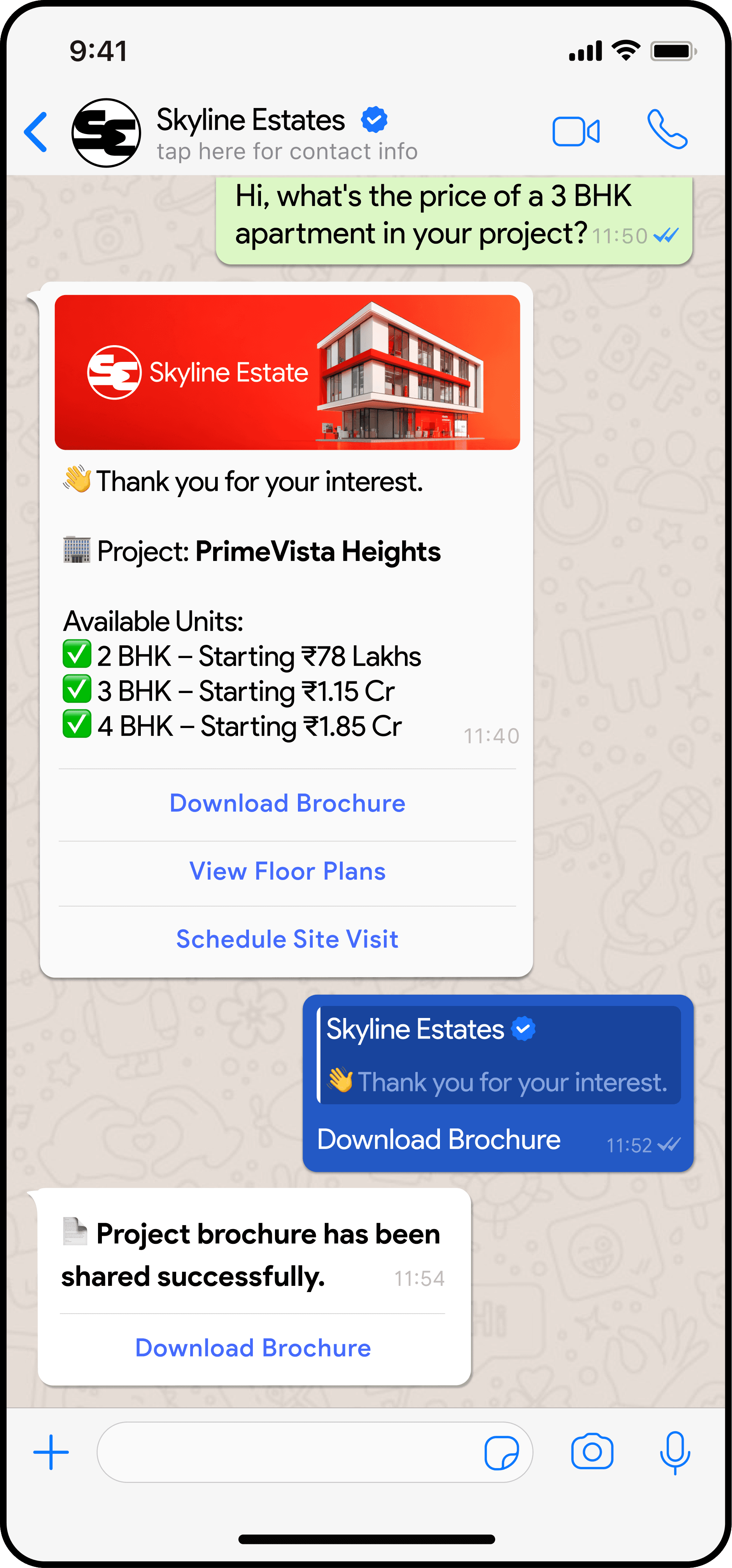
Dootiq identifies configuration and budget intent, checks project and inventory context, asks qualifying questions where needed, and routes the lead to sales with a complete buyer brief.
Outcome
The buyer receives a useful answer quickly, and the sales team receives a qualified lead instead of a raw form submission.
Real Estate Teams Cannot Treat Buyer Conversations Like Disposable Marketing Replies.
That Means Communication Infrastructure Must Preserve Context, Reduce Misalignment, And Keep Commercial Claims Consistent.
Was The Lead Contacted?
Did The Buyer Receive Accurate Guidance, And Can The Team See What Was Said?
Buyer responses should stay aligned with current project, availability, possession, and pricing guidance.
Buyers should not repeat requirements every time they move between WhatsApp, calls, site visits, and sales teams.
High-intent leads should reach agents with budget, project, preference, source, and conversation history intact.
Messages around pricing, availability, visit schedules, and promised follow-ups should remain visible for internal review.
Editorial Article
But lead generation is not the same as buyer progression.
The real estate customer journey breaks in the space between enquiry and meaningful sales conversation.
Dootiq helps real estate teams turn enquiries into qualified, scheduled, cross-channel buyer journeys.